

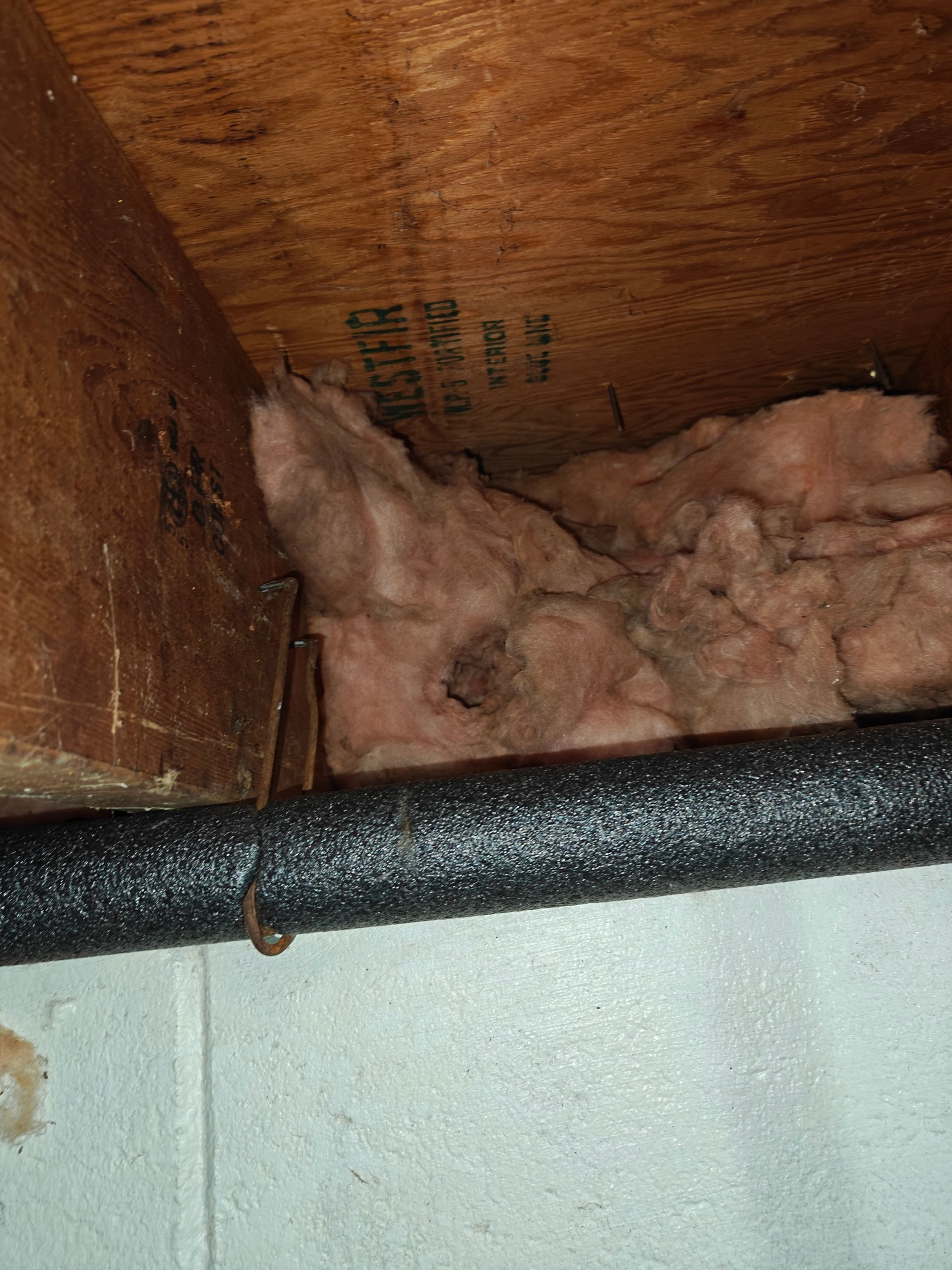
When you look up into a basement ceiling or wall cavity and see insulation that looks like this, that is not random damage. This photo was taken in a single family home in West Bend, Wisconsin, and it is a clear sign of rodent activity, specifically nesting behavior inside insulation.
Mice and rats both use insulation as a nesting material because it gives them exactly what they are looking for. It is warm, soft, and tucked away in areas that do not get disturbed often. Once a rodent gains access into a wall, ceiling, or rim joist area, insulation becomes one of the first places they settle in and build out a nesting site. What you are seeing in situations like this are burrows carved directly into the insulation. Rodents will tunnel into it and hollow out a protected pocket where they can rest, store food, and raise young. Over time, these areas become more defined and compacted from repeated use. In many cases, they will also become darker due to contamination from droppings and urine.
This is one of the biggest indicators that the issue is not just a one time visitor. Burrowed insulation almost always means there has been ongoing rodent activity. It shows that the rodent was comfortable enough to stay and establish a nesting area inside the structure. There is also an important difference between mice and rats when you look at this kind of damage. Mice typically create smaller, tighter burrows, often just large enough for them to fit into. Rats create larger and more aggressive burrows, with wider openings and more destruction to the surrounding insulation. The size and spread of the damage can give you a good idea of what you are dealing with.
These nests are most commonly found along rim joists, basement ceilings, attic insulation, and wall voids, especially near entry points like utility penetrations or gaps in the structure. Once rodents find a way in, they usually do not travel far before establishing a nesting area. Beyond the nesting itself, there are real concerns that come with it. Rodents will contaminate insulation with droppings and urine, and they will chew on nearby materials, including wood and wiring. Over time, that can lead to odor issues, insulation breakdown, and even safety risks.
The solution is not just removing the rodents. The real fix is identifying how they got in and sealing those entry points, along with addressing the nesting areas. If the entry points remain open, new rodents will take over the same space.
This is exactly why mice and rat control is included in our Proactive Pest Shield service for homes and our Commercial Pest Shield for businesses. On top of that, both homes and businesses benefit greatly from a dedicated mouse and rat proofing service, which focuses on sealing off access points and preventing rodents from getting in to begin with.
Most important takeaways: Burrowed insulation is a strong sign of active or past rodent nesting, mice create smaller burrows while rats create larger ones, and long term control requires both removal and proper sealing of entry points.
Are you concerned about a mouse infestation and live in or near Grafton, Saukville, West Bend, Germantown, Sheboygan, or Milwaukee? Call (262)-261-3925